Guide to the Fastest 3D Printer: Speed, Zero Waste, and the Multi-Material Revolution

Welcome to the post-speed era of desktop manufacturing. If you've been paying attention to the hardware evolution cycle heading into 2026, you already know that the market has undergone a violent architectural shift. The traditional Cartesian bed-slingers are dead, replaced entirely by the CoreXY kinematic dominance.
Today, hitting a 500mm/s or 600mm/s movement speed with 10,000mm/s² acceleration isn't a premium feature—it is the bare minimum requirement. Every major player, from the budget kings to the prosumer heavyweights, can now launch a printhead across an X-axis at breakneck speeds.
But here is the dirty little secret the industry doesn't want to talk about: when absolute physical speed hits the boundaries of physics, the marketing hype around the "fastest 3d printer" becomes an illusion. If everyone is fast, no one is. In 2026, the real battleground isn't about how fast your extruder moves in a straight line. It is about system-level engineering efficiency. It is about what happens when you introduce the brutal complexities of multi-color and multi-material fabrication.
The Speed Illusion Trap
Let’s apply first principles thinking to high speed 3d printing. A machine boasting a 600mm/s top speed looks incredible when printing a single-color, low-complexity geometric cube. But the moment you slice a highly detailed, multi-color model—say, a four-color articulating action figure or a mechanical prototype—that paper specification falls apart.
Why? Because of the filament swap time.
Current market-dominating solutions rely on single-nozzle filament switching systems, utilizing external automated material modules. The logic seems sound until you watch it operate. For every single color change on a layer, the machine must physically cut the filament, retract it all the way out of the Bowden tube, feed the new color in, wait for temperature stabilization, and then undergo an agonizingly long "purging" process to flush the old molten plastic out of the hotend.
If your printhead is spending 60% of its operational time parked over a purge chute, ejecting plastic waste, or building massive, useless prime towers, your machine is not fast. The true measurement of any fast 3d printer in 2026 must be its Total Mission Time and its Net Material Usage Efficiency.
The Ultimate Showdown: Single-Nozzle Swappers vs. Independent Tool Changers
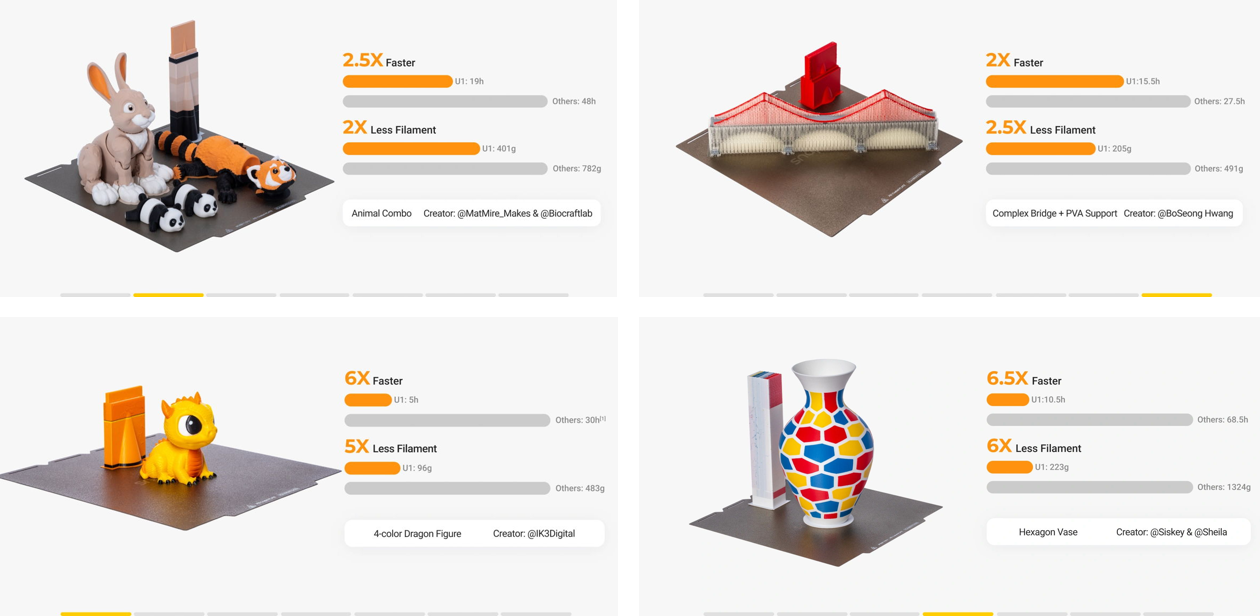
To understand why the paradigm is shifting, we need a hardcore comparison between the incumbent single-nozzle swappers and the true next-generation architecture: the independent tool changer.
When you use a single-nozzle system for complex multi-color tasks, the mechanical friction is staggering. A single color swap can take anywhere from 1 minute and 46 seconds to over 2 minutes. Multiply that by thousands of layer changes, and a print that should take 3 hours mechanically balloons into a 9-hour ordeal. Worse yet is the environmental and financial disaster known in the community as "printer poop." It is not uncommon for a single-nozzle system to generate 150 grams of unrecyclable purge waste just to print a 40-gram multi-color model. For businesses running print farms, this physically eats into your profit margins with every passing hour.
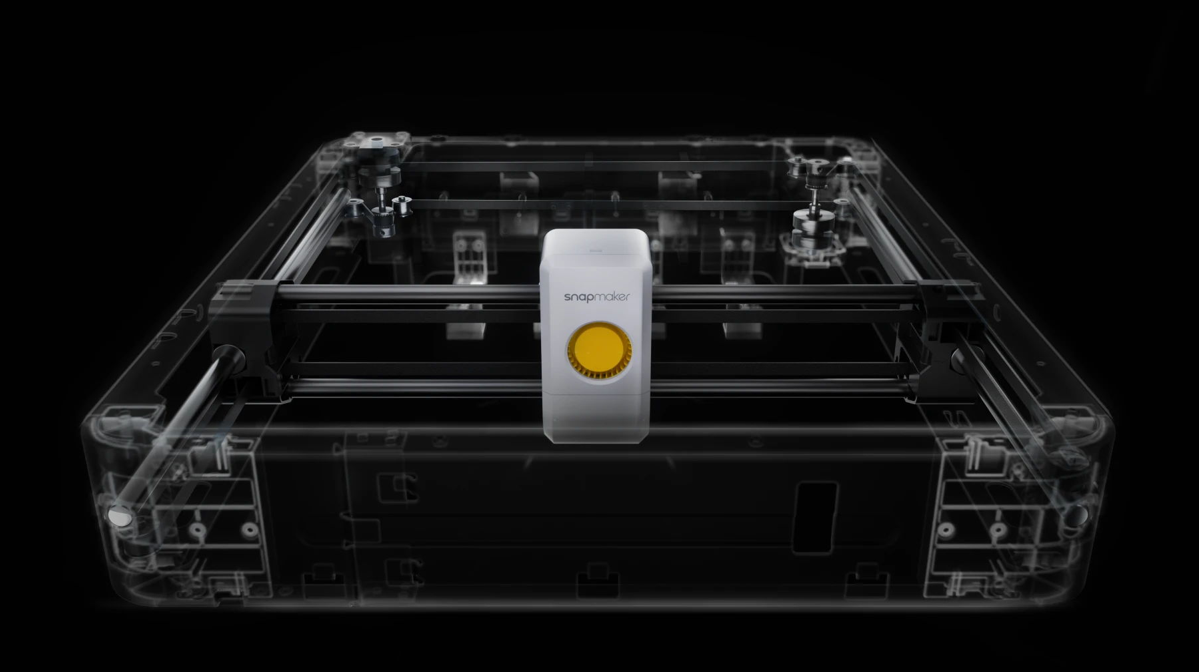
Enter the Snapmaker U1, a machine that is fundamentally rewriting the rules of the game with its independent quad-extruder tool-changing system.
Instead of fighting the physics of a single hotend, the Snapmaker U1 features four entirely independent extruders and hotend assemblies. When it's time to change colors, there is no cutting, no retracting, and absolutely no purging. Furthermore, it completely eliminates the need for massive prime towers (or wipe towers). In single-nozzle setups, these towers are a necessary evil—they exist solely to restabilize internal nozzle pressure and catch residual color bleed after a filament swap. Because each U1 nozzle is dedicated to a single material and kept ready at standby temperatures, the volumetric pressure remains perfectly stabilized. You just swap and print.
Through a proprietary, industrial-grade mechanism called SnapSwap™, the U1 utilizes ultra-precise steel-ball kinematic couplings to physically swap the entire toolhead.
The numbers speak for themselves:
- Swap Time: While single-nozzle systems take up to 2 minutes to flush and change, the Snapmaker U1 completes a physical toolhead swap in a blistering 5 seconds.
- Waste Reduction: Because each color has its own dedicated nozzle kept at standby temperatures, the U1 virtually eliminates purge towers and filament waste. It delivers up to an 80% reduction in wasted material.
- Reliability: The SnapSwap™ mechanism has been laboratory-tested to survive over 1,000,000 high-frequency tool changes without a single failure or degradation in accuracy.
If you are looking to truly reduce 3d printing filament waste cost or drastically improve your 3d print farm ROI, the math is brutally simple: The U1 offers 5X more speed in real-world multi-color scenarios and 5X less waste.
The Hardware Foundation for Uncompromised Speed
Of course, moving a massive gantry holding four toolheads at extreme speeds presents its own set of physics-defying challenges. When searching for the best fast 3D printer reviews, hardcore makers and engineers know that speed usually comes at the devastating cost of surface quality.
High-speed FDM printing introduces massive kinetic energy. When a heavy printhead makes a sharp corner, the inertia causes the frame and belts to shudder, creating microscopic resonant vibrations. This results in the dreaded visual artifacts on your final prints.
To combat this, Snapmaker threw out the traditional heavy metal linear rails. The U1 is built upon an ultra-lightweight, high-rigidity Carbon Fiber X-axis. By fundamentally reducing the moving mass of the gantry, the machine significantly raises its natural resonant frequency threshold.
But hardware is only half the battle. The U1 leverages the bleeding-edge Klipper architecture, utilizing built-in high-frequency accelerometers to perform active Input Shaping and vibration compensation. The algorithms predict the exact moment the machine will vibrate and send counter-frequency pulses to the stepper motors, effectively canceling out the resonance before it even happens. This is the ultimate, definitive solution for eliminating ringing and ghosting in fast 3D printers.
Furthermore, dealing with four separate physical nozzles could be a nightmare for calibration. Snapmaker solved this by integrating a fully automatic XYZ toolhead offset calibration system. Utilizing advanced optical sensors, the U1 maps the exact spatial position of all four nozzles, applying compensation algorithms to ensure that layer alignment during high-speed 5-second swaps remains accurate down to an insane 0.04 millimeters. The result? Resin-like surface quality at 500mm/s.
Beyond Color: The Multi-Material Revolution
For the casual hobbyist, printing a four-color plastic toy is a fun trick. But for industrial designers, engineers, and serious creators, the true Holy Grail of desktop manufacturing isn't just multi-color—it is multi-material.
This is where you must understand the critical difference between multi-material vs multi-color 3D printing.
Attempting to print true functional multi-material parts on a cheap, single-nozzle system is a recipe for catastrophic failure. Imagine trying to print a rigid mechanical gear out of PETG (which requires temperatures north of 464°F) and integrating a flexible, shock-absorbing TPU gasket (which requires lower temperatures and specific extruder tension).
Pushing these vastly different polymers through the same single melt-zone results in severe thermal degradation. The TPU will burn, the nozzle will suffer irreversible clogging, and the layer adhesion will completely fail. Single nozzles are simply not engineered for radical thermal shifting.
The Snapmaker U1’s toolhead changer makes this a problem of the past. Because it possesses four completely isolated thermal paths, you can seamlessly combine radically different engineering polymers in a single, uninterrupted slicing task.
You can print an impact-resistant ABS drone chassis perfectly bonded with flexible TPU landing pads. You can utilize high-flow PLA for rapid prototyping while dedicating toolhead number four exclusively to PVA (Polyvinyl Alcohol)—a water-soluble support material. This allows you to print incredibly complex overhangs and internal cavities, completely eliminating the risk of scarring your model during manual support removal. The U1 essentially compresses multi-step, post-processing assembly into a single, print-in-place digital manufacturing workflow.
Conclusion: The Desktop Micro-Factory is Here
For years, the industry accepted a frustrating compromise. If you wanted the speed and software ecosystem of a modern CoreXY machine, you had to accept the immense material waste and slow mission times of single-nozzle color swapping. If you wanted a true zero-waste, multi-material tool changer, you had to spend upwards of $3,500 on massive, bulky machines that dominated your entire workshop.
The Snapmaker U1 shatters that paradigm.
By engineering a robust, lightning-fast 5-second tool changer into a sleek, fully enclosed CoreXY frame with a generous 270 × 270 × 270 mm build volume, Snapmaker hasn't just built a fast machine—they've built a highly profitable desktop micro-factory. And at a disruptive entry price of under $1,000, it effectively makes the traditional "printer poop" producing machines obsolete for serious creators.
When looking at the landscape of 2026, the definition of speed has evolved. It’s no longer about how fast the nozzle moves; it’s about how much time the nozzle actually spends building your vision. Stop waiting for purges, stop throwing away expensive polymers, and step into the multi-material future.