3D Printed Lamp Ideas: Table Lamps, Shades, Night Lights & More

A 3D printed lamp turns lighting into more than a functional object. Instead of choosing from fixed shapes and finishes, you can experiment with curves, lattices, translucent panels, multicolor patterns, textured surfaces, and forms that would be difficult to create with conventional manufacturing.
That freedom makes lighting especially well suited to 3D printing. A lampshade can diffuse light through thin walls, repeated patterns can cast shadows across a room, and a familiar object can be reimagined as an entirely new light. With the right design and filament, the lamp can look just as interesting when switched off as it does when illuminated.
Below are several 3D printed lamp ideas created with different approaches to color, transparency, texture, and form. We will also cover how filament affects the final lighting effect and what to consider before turning a printed design into a working lamp.
If you are just starting to explore what your printer can make, our guide to 3D printing ideas for beginners offers more project inspiration beyond lighting.
Why 3D Printing Works So Well for Lamp Design
Lighting gives 3D printing an unusual opportunity: the printed geometry affects not only the shape of the object but also the way light passes through and around it.
Thin walls can soften and diffuse a light source. Ribs and perforations can create changing patterns of brightness and shadow. Curved surfaces can turn visible layer lines into part of the design rather than something that needs to be hidden.
Customization is another advantage. Instead of being limited to a standard lampshade or base, you can adjust a model for a specific desk, bedside table, room style, or lighting effect. Colors can also be coordinated across different printed parts.
This is why 3D printed lighting can range from relatively simple table lamps to sculptural pieces, translucent shades, lithophanes, novelty lights, and modular designs.
3D Printed Lamp Ideas to Inspire Your Next Project
1. Stained-Glass-Style Lamp With Translucent Panels
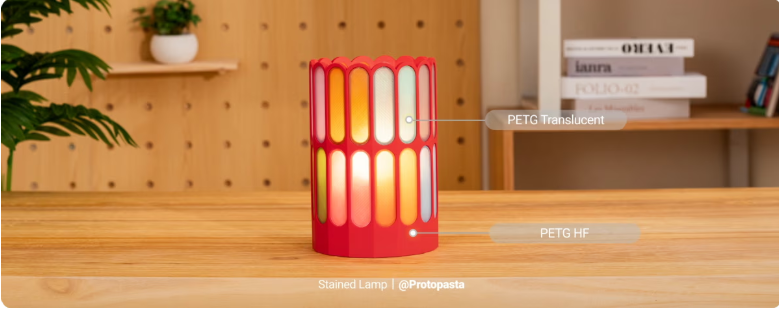
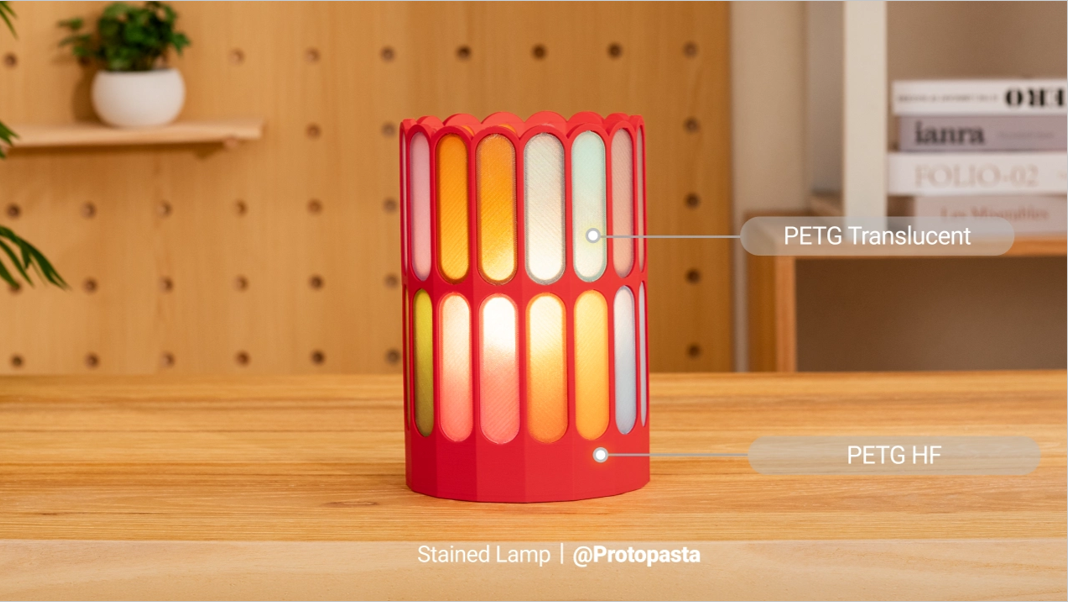
This Stained Lamp combines an opaque PETG HF frame with differently colored PETG Translucent panels, showing how material choice can become part of the lighting design itself.
When the lamp is off, the contrast between the solid red structure and translucent inserts defines the form. Once illuminated, the panels become the focal point as different colors transmit and diffuse the light.
This approach can be adapted to geometric lamps, lanterns, mosaic patterns, window-inspired designs, or abstract color compositions.
Our PETG Translucent filament is designed for applications such as lampshades and light diffusers. By adjusting the number of wall loops, you can also influence the final appearance: fewer walls allow more light to pass through, while additional walls create a softer, more diffused effect.
If you want to explore the material itself in more detail, see our guide to PETG filament.
For a 3D printed lampshade, this means filament and wall construction are not simply printing parameters. They are part of the visual design.
2. Multicolor Gradient Wave Lamp
Not every lamp needs translucent filament to make an impression. Shape, texture, and color can do just as much.
Our Multicolor Gradient Wave Lamp uses a rounded, ribbed form with color transitions across its surface. When illuminated, the raised texture catches light differently across the curved body, emphasizing a pattern that is already visible when the light is off.
Wave-like and ribbed forms work particularly well for 3D printing because repeated geometry can be built directly into the model. Instead of treating layer structure as something that always needs to disappear, the design can use repetition and surface texture intentionally.
For a sculptural 3D printed table lamp, possible approaches include:
- vertical ribs that emphasize height;
- spiral or twisted surfaces;
- repeating geometric openings;
- organic wave patterns;
- multicolor sections that change with the viewing angle.
If color itself is part of the design concept, our collection of inspiring multicolor 3D prints shows more ways different colors can become part of the printed geometry.
This is where 3D printing can move beyond reproducing a conventional lamp and become part of the visual design itself.
3. RocketBoost Lamp for a Playful Desk Setup
A lamp can also function as a decorative object.
The RocketBoost Lamp turns a rocket-shaped model into a compact desk light, using the illuminated lower section as the rocket's exhaust plume. Instead of simply placing a light inside an unrelated model, the illumination completes the visual idea.
That makes this type of project especially suitable for desks, gaming spaces, bedrooms, and creative workspaces.
The same principle can be applied to designs where illumination has a logical role in the object:
- a campfire with a glowing flame;
- a lighthouse with an illuminated top;
- a crystal or gem with internal lighting;
- a spaceship with glowing engines;
- a mushroom with a luminous cap.
These projects show that a 3D printed lamp does not have to resemble a traditional lamp at all. The most memorable designs often make the light source part of the concept.
4. Milk Carton Lamp: Reimagine a Familiar Shape
The Milk Carton Lamp takes a familiar everyday form and reinterprets it as a fully 3D printed lighting object.
The lamp body itself is 3D printed rather than built around an existing carton. Its recognizable packaging-inspired shape makes the design immediately understandable, while the illuminated section gives the object an entirely different function.
Multicolor printing also allows graphics, contrasting areas, and structural details to be integrated directly into the model.
The same approach can inspire lamps based on other familiar forms:
- bottles or cans;
- cameras;
- retro electronics;
- architectural shapes;
- food packaging;
- household objects.
The goal does not have to be perfect realism. Simplifying a familiar form, exaggerating its proportions, or changing its colors can produce a more distinctive piece of 3D printed home decor.
5. Lithophane and Personalized Night Lights
For something more personal, a 3D printed night light can use light to reveal an image.
Lithophanes create an image through variations in printed thickness. When unlit, the surface may appear relatively subtle. Once illuminated from behind, thinner and thicker areas transmit different amounts of light and reveal the picture.
That makes lithophane lights particularly suitable for:
- family photographs;
- pets;
- landscapes;
- travel memories;
- personalized gifts;
- decorative image panels.
A night light does not need to use a photograph either. Names, symbols, simple graphics, stars, or patterned translucent surfaces can all create soft ambient lighting.
Because these projects depend heavily on transmitted light, print thickness and filament selection matter more than they do for an opaque lamp base. If you want to experiment further with transparency and light transmission, our guide to 3D printing with clear filament covers the main factors that affect the final result.
6. Modular and Geometric Lamps
Another strength of 3D printing is the ability to divide a larger design into repeatable parts.
Instead of printing one large lamp body, a modular design can use identical or compatible sections that connect together. This can make complex geometric lighting easier to produce and allows a design to be expanded, rearranged, or repaired one section at a time.
Possible concepts include:
- stacked rings;
- repeated lattice panels;
- polygonal modules;
- interlocking shades;
- rotating geometric sections;
- modular wall lights.
Repeated structures can become especially interesting once illuminated because each opening and edge interacts differently with the light source.
How Filament Changes the Look of a 3D Printed Lamp
The model is only part of the finished result. Filament can dramatically change how the same lamp looks both illuminated and unlit.
For lighting projects in particular, translucent materials deserve extra attention. With our PETG Translucent, wall-loop count can be used to adjust the balance between light transmission and diffusion: fewer wall loops favor greater transmission, while additional loops soften the light.
You can browse our full range of 3D printer filaments to compare translucent, matte, silk, wood, multicolor, and other material options for different lamp designs.
There is no single “best” filament for every lamp. A sculptural base, colorful decorative body, structural frame, and light diffuser may each benefit from a different material or finish.
What to Consider Before You 3D Print a Lamp
A lamp combines a printed object with lighting and electrical components, so appearance should not be the only consideration.
- Start with the light source. Low-heat LED lighting is generally the practical choice for printed lamp projects. Always follow the temperature, clearance, ventilation, and enclosure requirements specified for the lighting and electrical components you use.
- Keep heat away from printed parts. A filament's heat-deflection or softening temperature describes a material property; it should not be treated as a safety rating for an assembled lamp. Design enough clearance around bulbs, drivers, sockets, and other components, and avoid configurations that trap heat.
- Think about diffusion before printing. A thin translucent wall may transmit more light but also make the individual light source more visible. A thicker or multilayer surface usually produces a softer effect. Texture, color, wall count, and geometry all influence the result.
- Design for stability. Table and desk lamps need a base that is wide and stable enough for the finished height and weight. Taller decorative designs may require additional attention to their center of gravity.
- Treat electrical hardware separately from the printed housing. A printed lamp body or shade does not replace appropriately rated wiring, sockets, switches, power supplies, or other electrical components. Use electrical components that are suitable for the intended application and follow their installation instructions.
These considerations become especially important when moving from a decorative prototype to a lamp intended for regular use.
Turn Light Into Part of the Print
The most interesting 3D printed lamps do more than reproduce conventional lighting. They use translucency, texture, color, geometry, and personalization to make light part of the design itself.
The Stained Lamp uses translucent panels to shape color. The Gradient Wave Lamp turns surface texture and multicolor printing into part of the visual effect. The RocketBoost Lamp uses illumination as an exhaust plume, while the fully printed Milk Carton Lamp shows how a familiar everyday form can become an entirely new lighting object.
For your next project, start by deciding what role the light should play. Should it pass through the model, reveal a hidden image, emphasize a texture, or complete the form? Once that is clear, choosing the right geometry and filament becomes much easier.
FAQ About 3D Printed Lamps
Can you 3D print a lamp?
Yes. You can 3D print lamp bases, shades, diffusers, decorative bodies, and many structural elements. A working lamp will still normally require separate electrical components such as an LED light source, wiring, socket, switch, or power supply.
What filament is best for a 3D printed lamp?
It depends on the part and the visual effect you want.
Opaque PLA or PETG can work well for structural and decorative components, while translucent PLA or PETG is more suitable when light needs to pass through the print. Matte, silk, wood-look, and multicolor filaments can add different surface and color effects when appearance is the priority.
Can PLA be used for a 3D printed lampshade?
PLA can be used in some lamp designs, but the complete lighting setup matters. PLA has relatively limited heat resistance, so printed components need to be kept away from excessive heat and used with lighting hardware that operates within the appropriate thermal and clearance requirements.
Choosing PLA alone does not make a lamp safe.
How can you make a 3D printed lampshade more translucent?
Material, wall thickness, layer height, geometry, and internal structures all influence translucency.
With our PETG Translucent, fewer wall loops allow more light to pass through, while additional wall loops create a softer diffused effect. For shell-like lampshades, reducing unnecessary internal structures can also help prevent unwanted light scattering.
Can an entire lamp body be 3D printed?
Yes. Our Milk Carton Lamp is one example of a complete decorative lamp body produced through 3D printing rather than by adding printed parts to an existing carton or lamp shell.
The printed body can define the shape, color, texture, and diffusion characteristics, while the actual light source and electrical hardware remain separate components selected for the intended use.