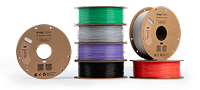
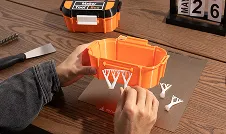
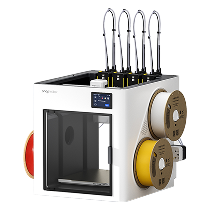
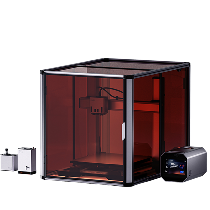
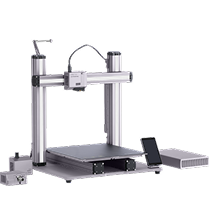
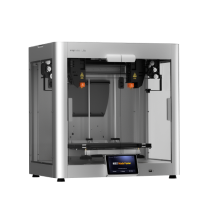
3D printed models made with Snapmaker filament, highlighting material range and precision.

3D Printing Filaments Guide

Choosing the right filament is halfway to success of 3D prints. And the rest counts on the settings. This table presents the properties of various filaments, the recommended print settings, and the ideal applications, for you to see the tradeoffs between filaments and what works best for your intended use.
Filaments
Colors Available
Weight
Diameter
Printing Temperature
Heated Bed Temperature
Recommended Printing Speed
Young’s Modulus
100% Modulus
Tensile Strength
Bending Strength
Charpy Impact Strength
Glass Transition Temperature
Vicat Softening Temperature
Melting Temperature
Elongation at Break
Shore Hardness
Applications

Basic PLA

Learn More
500 g/1 kg
1.75 mm
190˚C–210˚C
25˚C–60˚C
40 mm/s–60 mm/s
2636 ± 330 Mpa
46.6 ± 0.9 Mpa
85.1 ± 2.9 Mpa
2.7 ± 0.2 kJ/㎡
61˚C
63˚C
150˚C
For indoor use
Prototypes, decorations, props, electronics gadgets
1 kg
1.75 mm
210˚C–230˚C
25˚C–60˚C
20 mm/s–40 mm/s
9.4 ± 0.3 Mpa
29 ± 2.8 Mpa
330.1 ± 14.9 (%)
95A
For indoor and outdoor use
Footwear, protective cases, 3D printing gadgets

PETG HF

Learn More
1 kg
1.75 mm
240˚C–260℃
60˚C–80℃
< 300 mm/s
2311.11 ± 92.41 MPa
-
47.96 ± 4.88 MPa
80.08 ± 3.53 MPa
4.95 ± 0.55 kJ/m²
71.24°C
75°C
-
-
-
Weather-resistant & durable; maintains shape/toughness indoors and out
1 kg
1.75 mm
240˚C–260˚C
80˚C–100˚C
30 mm/s–50 mm/s
2174 ± 285 MPa
33.3 ± 0.8 MPa
59.0 ± 1.3 MPa
12.6 ± 1.1 kJ/㎡
101˚C
104˚C
For indoor and outdoor use
Prototypes, home appliances, cases
500 g
1.75 mm
215˚C–225˚C
25˚C–60˚C
30 mm/s–40 mm/s
For water-soluble support
1 kg
1.75 mm
250˚C–270˚C
25˚C–50˚C
30 mm/s–60 mm/s
2223 ± 199 MPa
66.2 ± 0.9 MPa
97.0 ± 1.1 MPa
9.6 ± 1.4 kJ/㎡
67˚C
180˚C
190˚C
For indoor and outdoor use
Mechanical parts, nuts and bolts, home appliances

Breakaway Support for PLA

Learn More
1 kg
1.75 mm
220˚C–230˚C
25˚C–60˚C
20 mm/s–40 mm/s
For easy-to-remove support