PETG vs. ABS: Which "Heavy Duty" Filament Do You Actually Need?

You’ve mastered PLA. You’ve printed enough benchies and vases to fill a shelf. Now, you need a part that can actually do some work—a gear for a robot, a replacement latch for your car, or a bracket for your workshop.
Naturally, you look at the "stronger" options: PETG and ABS.
If you browse the forums, you’ll see a confusing war of words. Some claim "ABS is dead" and that modern PETG has replaced it. Others swear that real engineering parts can only be made with ABS. Then there are the warnings about toxic fumes and warping nightmares.
So, what is the truth? And more importantly, is your printer actually capable of handling them?
This guide will break down the PETG vs. ABS debate, address the safety concerns, and help you decide which material belongs in your toolkit.
The Elephant in the Room: Is ABS Dead?
Let’s address the biggest forum debate first. Many makers argue that ABS (Acrylonitrile Butadiene Styrene) is obsolete. They claim that because PETG (Polyethylene Terephthalate Glycol) is easier to print, ABS is no longer necessary.
They are half-right. For 80% of "functional" prints, PETG has replaced ABS. It’s easier and requires less hardware. However, ABS is definitely not dead. It holds three specific superpowers that PETG simply cannot touch:
- Extreme Heat Resistance: ABS survives temperatures (~100°C) that would turn PETG into a droopy mess.
- Post-Processing: ABS can be chemically smoothed to look like glass (more on that later).
- Lightweight Strength: ABS is less dense than PETG, making it better for drone parts or lightweight robotics.
PETG vs. ABS: The Core Differences
Heat Resistance: The "Hot Car" Test
This is the main reason to choose ABS.
- PETG softens around 80°C. It is great for outdoor planters or brackets in the shade, but it might deform inside a black car parked in the summer sun.
- ABS can withstand temperatures up to 100°C. If you are printing a fan shroud for your printer’s hot end, a dashboard mount for your car, or parts for a dishwasher, ABS is the required standard.
Ease of Printing: The "Warp" Factor
This is where PETG shines.
- PETG is like "spicy PLA." It prints on a moderately heated bed (70–80°C) and generally sticks well. It doesn't shrink much as it cools, meaning you can print it on an open-frame printer without much trouble.
- ABS is notorious for warping. As it cools, it shrinks significantly. On an open printer, the corners of your print will curl up, or the layers will split apart. To print ABS successfully, you must keep the air around the print hot.
Finish and Post-Processing: The "Acetone Trick"
PETG is chemically resistant, which is a pro and a con. It’s hard to glue and impossible to smooth chemically. You are stuck with the layer lines unless you sand it for hours.
ABS reacts to acetone. You can place an ABS print in a container with acetone vapor, and the surface will melt slightly, fusing the layers together. The result is a glossy, injection-molded look that is completely smooth. For cosplay props or consumer-product prototypes, this is a game-changer.
The "Scary" Stuff: ABS Fumes and Safety
You’ve likely heard that ABS is toxic. Let’s separate fact from fear.
When melted, ABS releases Styrene, a colorless gas that smells like burning plastic. High concentrations can cause headaches, drowsiness, and irritation.
- PETG: Odorless and generally considered safe (though ventilation is always good).
- ABS: Smells strong and releases Volatile Organic Compounds (VOCs).
Does this mean you shouldn't use it? No. It means you need the right tool.
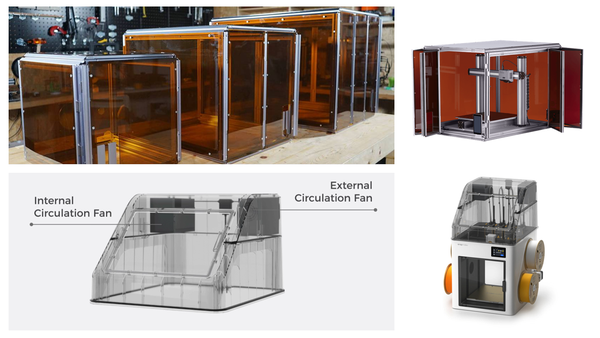
This is where a machine like the Snapmaker U1 paired with Top Cover becomes essential. The Top Cover doesn't just keep the heat in; it includes a built-in exhaust fan and a three-layer air filtration system. If you are printing ABS at home, you need an enclosure that can filter or vent these fumes away from your living space.
Safety Tip: Never print ABS in a small, unventilated bedroom without an enclosure. Read more about 3D printing fumes here.
Hardware Check: Can Your Printer Handle It?
This is the most important section. You can buy a spool of ABS for $20, but you can't just load it and hit print.
For PETG:
- Printer: Any standard heated-bed printer.
- Nozzle Temp: 230–240°C.
- Bed Temp: 70–80°C.
- Enclosure: Not required (but helps with layer adhesion).
For ABS:
- Printer: Must have a high-temp bed and an enclosure.
- Nozzle Temp: 245–265°C.
- Bed Temp: 90–105°C (This is critical).
- Enclosure: Mandatory. Without the Snapmaker Top Cover (or a similar enclosure), cool drafts will cause your ABS print to crack mid-print.
The Snapmaker U1 Advantage:
If you own the Snapmaker U1, adding the Top Cover unlocks "Passive Chamber Heating." The heat from the bed is trapped inside, raising the ambient temperature. This prevents the ABS from shrinking too fast, ensuring your parts come out flat and strong.
Comparison Table: PETG vs. ABS Filament Specs
[Data Source: Snapmaker Official Filament Specs]
Final Verdict: Which Spool Should You Buy?
Don't buy ABS just because it sounds "pro." Buy it if you have the hardware to support it.
- Stick to PETG if: You want a "set it and forget it" strong filament for brackets, waterproof tool holders, or outdoor planters. It gives you 80% of the strength of engineering materials with none of the hassle.
- Upgrade to ABS if: You have the Snapmaker Top Cover, and you need parts that withstand high heat (car interiors) or you want that perfectly smooth, glossy finish for a prop.
Ready to start printing? Check out our guide on how to succeed with PETG or explore the Snapmaker U1 to get your machine ABS-ready.
FAQ on PETG vs. ABS
Can I print ABS on an open printer?
Technically yes, but practically no. Small parts might succeed, but anything larger than a few inches will likely warp, curl off the bed, or crack due to uneven cooling. An enclosure is highly recommended.
Is PETG stronger than ABS?
In terms of tensile strength (pulling), they are often similar. However, PETG is more flexible and has better layer adhesion, meaning it is less likely to split along the layer lines. ABS is lighter and harder, but layer separation is a common weak point if not printed in a warm chamber.
How do I get rid of the ABS smell?
Use an enclosure with an air purification system, like the Snapmaker Top Cover. Alternatively, ensure the room is well-ventilated by opening a window or using an exhaust fan.
Does PETG degrade in the sun?
PETG has very good UV resistance, making it an excellent choice for outdoor parts. It generally outlasts standard PLA and untreated ABS when exposed to direct sunlight.